
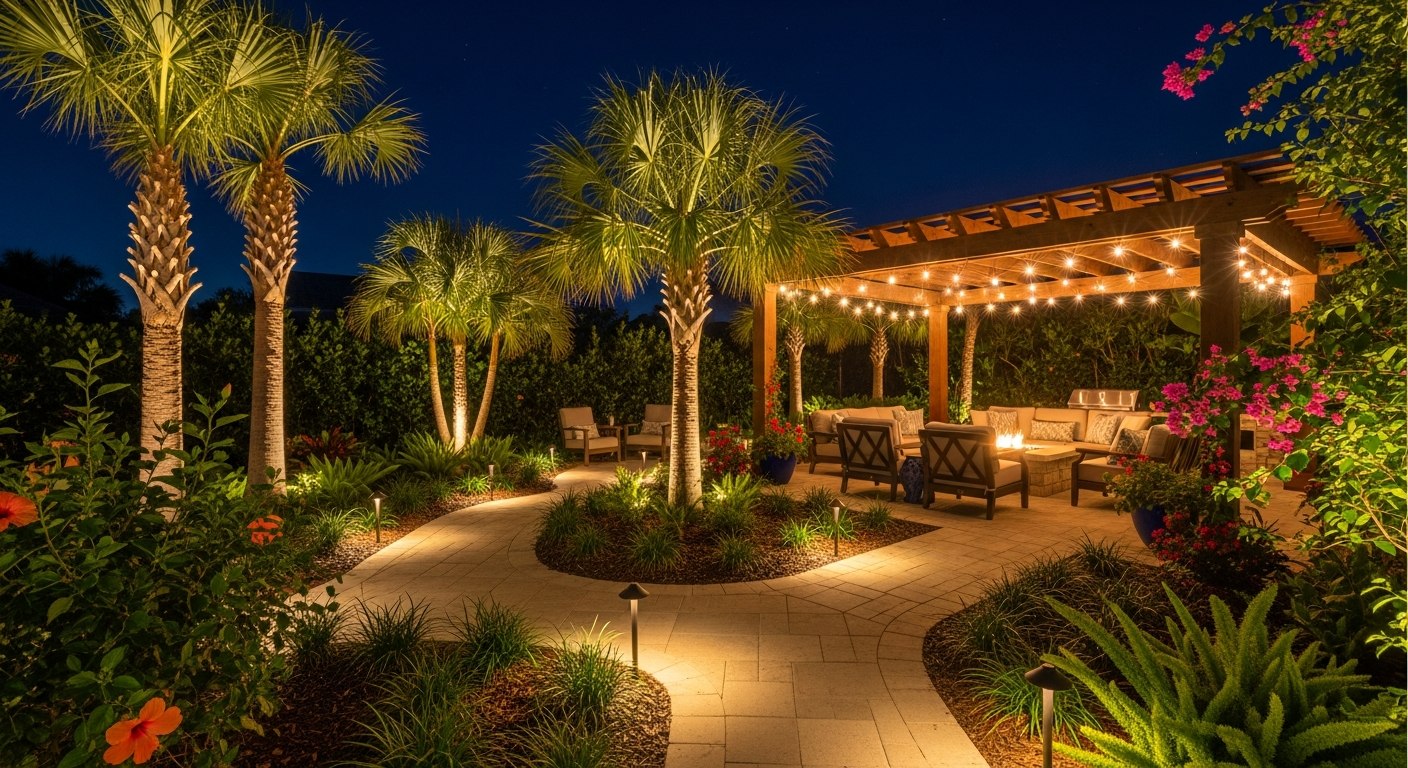
Low-Voltage Landscape Lighting in Fernandina Beach, FL
Add safety, security, and usability to your outdoor space — without running line voltage through your yard.
What low-voltage landscape lighting does
Low-voltage landscape lighting runs on 12 volts instead of 120-volt line power. That means it's safer to install in the ground, safer to work around, and doesn't require a licensed electrician for the fixture installation — though it does connect to a transformer that plugs into a standard outdoor outlet.
The practical result: you can light your paths, accent your trees, illuminate your patio, and add security and curb appeal to your property without the complexity and cost of high-voltage outdoor electrical work.
SDS Construction installs landscape lighting as part of full outdoor builds and as standalone projects. If you're adding a patio and a pergola, we run the wiring before the concrete is poured and the pergola posts are set. If you just want lighting in an existing yard, we can do that too.
Fixture Types & Applications
Path and walkway lighting
Low-profile fixtures installed along walkways, driveways, and garden paths. These are safety features as much as they are aesthetics — they define where to walk at night and prevent trips on uneven ground. We space them correctly so you get even illumination without a runway effect.
Accent and uplighting
Fixtures aimed upward at trees, palms, architectural features, or landscape plantings. Uplighting creates drama and depth in a yard at night — it's the difference between a yard that disappears at sundown and one that looks intentional and well-designed.
Patio and deck lighting
Downlights mounted in pergola rafters or overhead structures, step lights built into deck risers, and in-ground fixtures recessed into the patio surface. Patio lighting makes your outdoor living area usable after 7pm — which in Florida is when the temperature finally becomes comfortable anyway.
String lights and café lighting
Outdoor-rated string lights strung between pergola rafters, posts, or mounting points. Popular for entertaining areas. We use outdoor-rated LED strings and mount them properly so they don't sag or fail in the first thunderstorm.
Pool and water feature lighting
Lighting around pool decks, fountain bases, and water features. We use appropriate wet-location rated fixtures and run wiring safely away from the water.
Tree and palm lighting
Uplights, moonlighting (fixtures mounted high in trees aimed downward), and wrap-around accent lighting for large trees and palms. Florida's tropical plantings — cabbage palms, Sabal palms, live oaks — look spectacular when properly lit.
Security and perimeter lighting
Motion-activated and always-on perimeter lights at dark corners, side yards, and entry points. These aren't just aesthetics — they're practical deterrents and safety improvements.
Lighting repair and service
If your existing landscape lighting isn't working right — fixtures that go dark, transformers that fail, wiring damaged by landscape crews — we diagnose and repair it. We work on systems we didn't install.
Why Construction-Integrated Lighting is Better
Most lighting specialists install fixtures after everything else is done. That means conduit runs on top of the patio surface instead of under it, wiring that goes around obstacles instead of through them, and fixtures positioned where the wire can reach rather than where they'd look best.
When we handle lighting as part of a full outdoor build, the wiring plan happens before the concrete is poured. Conduit runs under the slab. Junction boxes are positioned exactly where the designer wants fixtures. Everything is cleaner, more flexible, and doesn't look retrofitted.
If you're planning a patio, pergola, or outdoor kitchen, bring lighting into the conversation from the start — even if you're not installing it until a later phase. It costs almost nothing to run conduit while the trench is open and the concrete is still wet. Running it after costs real money.
Lighting Design Basics
We're not a lighting design firm — but we've installed enough systems to know what works and what doesn't. Here's what we think about when we're planning a system:
Layers of light
Good outdoor lighting has multiple layers: ambient (general illumination), task (functional light for paths and stairs), and accent (decorative uplighting and feature lighting). A system that only has one type tends to look flat or overdone.
Color temperature
Warm white (2700K-3000K) is the standard for residential landscape lighting. It matches interior lighting visible through windows and looks natural on plants and wood. Cool white can look harsh and clinical outdoors — we generally avoid it for residential applications.
Fixture placement
Path lights need to be close enough together to provide even coverage without being so close they look like an airport runway. Uplights need to be aimed carefully or they glare into people's eyes from low angles. These are things we get right through experience, not guesswork.
Transformer sizing
The transformer is the hub of the whole system — it controls timer functions, dimming, and load capacity. Undersized transformers are one of the most common problems we see in DIY and budget installations. We size transformers for the actual load plus reasonable future expansion.